

"Thunderball" by Melvins
Is grunge making a comeback?

⏳ On This Day of Music History 🎶 June 25, 2009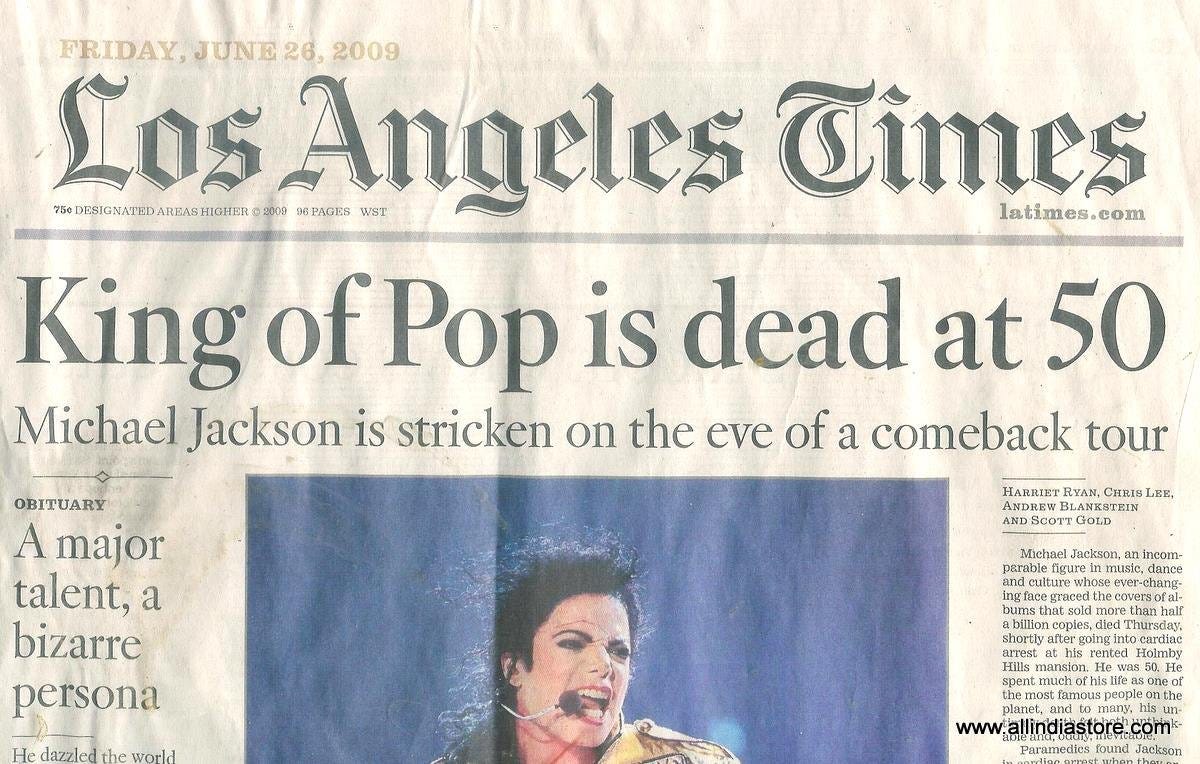
King of Pop, Michael Jackson, passes away from propofol intoxication in L.A., aged 50. His doctor had infamously given him the wrong dosage and then had not called 911, resulting in him being convicted for involuntary manslaughter. Following his death, there were unprecedented surges of internet traffic and a spike in his music sales. His televised memorial service at the Staples Center had 2.5 billion viewers.
Is grunge coming back?
Before you eagerly put on your Doc Martens and flannel shirt, I hate to break it to you, but grunge will never truly come back. This trademark sound with heavy distortion and Drop D tuning is particular to a specific coordinate in the plane of the space-time continuum, that point being (Pacific Northwest, Late ‘80s to Early ‘90s).
Grunge is a musical genre that is defined not as much by the music as it is by its attitude. Picture this:
Going through the hormonally tumultuous time that is teenage and early-twenties-hood, an angsty “Gen X-er” comes back from school only to find an empty house. A “latchkey kid” of course. Unhappy with the policies the Reagan Administration is putting forth, in combination with feeling misunderstood by their divorced Baby Boomer parents, this kid feels failed by the institutions they were told would protect them. Consequently, they go into their room and blast the hardcore punk band Black Flag’s breakout album “Damaged.” Their present reality rife with confusion and chaos, the future doesn’t offer much solace either. With the impending end to the millennium, who knows what future will succeed that transitional point in time? To add insult to injury—or dissonance to distortion—job prospects seem grim thanks to this new technology called the Internet, which appears to have the capability of replacing human beings. The teenager sighs, lying on their bed, staring at the ceiling, feeling a need for an outlet for this very specific feeling that no one else outside of their generation can relate to. Thus grunge music was born.
While modern bands can emulate the grunge sound, it wouldn’t be considered true grunge as it is devoid of the specific sentiments and experiences that defined the Gen X youth in the ‘80s and ‘90s, as chronicled in the stereotypical depiction above. No one else outside of that specific space and time can truly walk in the same Converse All-Star shoes.
Lyrics from popular grunge songs such as, “Here we are now, entertain us / I feel stupid and contagious,” from Nirvana’s “Smells Like Teen Spirit, or, “Feed my eyes, can you sew them shut?” from Alice in Chains’s “Man in the Box” evoke the disillusionment and apathy felt by a generation marked by specific political and social contexts. Subsequent generations can (and do) still write similar lyrics, however, they wouldn’t be inspired by the same cultural context that fed into the music made by Gen X. With this crucial ingredient missing, grunge, in its original form, can never make a comeback.
But don’t fret—that era’s vinyl may be scratched, but the record keeps on spinning. While there might be truth in the saying ‘grunge is dead, the principle behind it will continue to live on for as long as the younger generation will feel angsty and misunderstood. These primitive feelings of alienation, disillusionment and confusion, especially in response to what is going on in the world, are trademarks for anyone in their teens and early 20s and these themes can be in any kind of music whether it be rapped on top of a pounding snare drum beat or belted over an emotional piano ballad. When it comes to grunge in its original form, that last chord has already been strummed, but the principle behind it still continues to play.
So while newer generations can imbibe the values behind the music without exactly being able to replicate it, where does that leave the original grunge artists who are still making music? While most of the prominent grunge musicians are no longer active or are deceased, there are still a few that are putting out music to this day. Would their music be considered grunge? Yes, it’s not the ‘80s and ‘90s anymore, yes, people aren’t wearing chokers, yes people are no longer stressed about the Reagan administration or the AIDS epidemic, these experiences were still part of these artists’ lives, and that too during their formative years. As a result, the music they make can still be fueled by those same feelings produced by the same events of the original grunge era, and also be in the same musical style. So where does music made by the original grunge musicians stand? Would it still be considered grunge?
To examine this question I decided to review “Thunderball,” by the Melvins, released on April 18 2025 which is their 26th studio album in the 38 years they’ve been active. The Melvins, originally comprised of Buzz Osborne as lead vocalist and guitarist, Mike Dillard on drums and Matt Lukin on bass, had their humble start in the gloomy town of Montesano, Washington. These high school friends started their band in 1983, and named it after a clerk in a grocery store that Osborne worked in. This clerk, Melvin, was one of the most disliked employees, so the three thought it would be hilarious to name their band after him, in the self-referential irony that would become a trademark of Gen X.
The Melvins were an interesting transition point in rock music history. They were the band that bridged the gap between metal and grunge, thus creating a new subgenre of alternative culture that had the musical roughness without the macho showmanship of ‘80s hair metal that the Pacific Northwest punk crowd craved. A new genre for a new generation. The Melvins were the biggest—non-mainstream—band in rural Washington towns, amassing crowds of teenage misfits at their rehearsals. Among these were the sardonic Mark Arm (later to form Green River, the first true grunge band, and then later Mudhoney), the boisterous Krist Novoselic (who would become Nirvana’s bassist) and even the moody Kurt Cobain himself. In fact, these gritty rehearsals, taking place in smoke-filled basements, with distorted chords being jammed on duct-taped guitars, blaring out of thrift-store amps, is where Kurt and Krist met and later formed Nirvana together.
Essentially, we have the Melvins to thank for the existence of grunge. And consequently alternative rock and consequently emo and consequently pop punk and consequently nostalgia-core, which ironically circles back to the previous decades that led to its existence in the first place. Like with a vinyl record, the stylus goes continuously around the record, going near its previous location, but never actually touching it.
Having been decades since this era, I was curious to see how this sound has evolved to this day. Does it still have remnants of the original grunge, or has it shifted into a new genre entirely? And how will Gen Z take this musical movement from there?
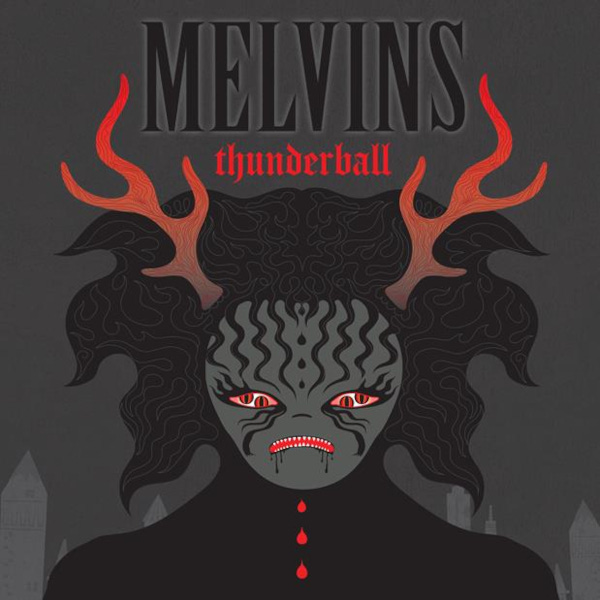
The album kicks off with “King of Rome” blaring some hardcore Black Sabbath riffs. With the intensity right off the bat, it signals that this album is not vying for mainstream appeal, but for those who get “it.” I wonder which of those two categories I fall into. The dual vocals slither around the lead guitar, begging the question, Is this what it feels like to walk through the gates of hell? At least the album cover checks out. The sound is similar to a traditional metal song if it weren’t for the synthesizer keyboard dithering around in the background. Giving it a more new-age sound, there seems to be a separation between the band’s grunge and metal roots. Regardless, those who like the Melvins’ traditional sound will appreciate this introduction to the album
The second track is where things start to get a little more confusing. At first I thought I was listening to a metal album but now I feel like I’m walking into a post-apocalyptic void, which is also kind of akin to the album cover. And I know this is an album review and not an album cover review, but couldn’t they have created a more detailed design? It looks like a graphic design intern used a free Canva template an hour before the deadline. Additionally, the frumpy hair leads me to believe it’s meant to be a drawing of Obsorne himself. The change in tone is as if in the studio, after they stopped recording the previous song, they turned off all the other instruments and vocals, but accidentally left on the synthesizer keyboard for a couple minutes, and then just decided to leave it in the album. The name “Vomit of Clarity” is fitting since it really does feel like a feeling of clarity has left my body.
The Melvins really seem to be into their synthesizer these days because the first minute of “Short Hair With A Wig” sounds like an 8-bit video game soundtrack. Maybe they’re just ‘80s kids at heart. When that segment was over, a moment I thought would never arrive, a Metallica-like riff proceeds for an immeasurably long time. Though a pretty cool progression, the jilted nature of the chords in addition to the continuous cymbals makes me feel like I’m Sisyphus pushing that boulder up a mountain—effortful with no reward and once it’s over I feel like I have to do it all over again. As if that wasn’t ominous enough, the next segment has this haunting yet authoritative chanting, the slow lead guitar and beat with deep bass sounding like what would play before a human sacrifice in a cult. The suspenseful backup guitar leads me to believe that I’m the one who’s going to be sacrificed. Before I can hatch an escape plan or wonder how I accidentally joined this cult in the first place, the music fades out in that familiar 8-bit sound that makes me question if any of this actually happened at all. To top it off, the song ends with a guitar chord that sounds like if you were to add a grunge distortion pedal onto the sound of a fly buzzing.
With “Victory of the Pyramids,” it sounds like they thought, “Hey, we’ve scared you enough, let’s give you a break with this fun, indie, summer song…that’s long enough to last the whole summer.” It’s nine minutes. This could be something one would hear at the start of a coming-of-age movie if it weren’t for the grungy, heavily distorted backup guitar. Still, the impressive drumrolls make me excited for what’s to come. Alas, I’ve woken up from my stupor. This appears to be the first song in the album that follows the traditional four-chord format. But then suddenly the tone changes and it sounds as if you were to ask ChatGPT to make a Metallica song (in a good way). Then the tone changes again for some reason, so I don’t really understand why they didn’t split this into 3 separate songs. Wait a minute, I recognize this feeling, oh no I’m back in the cult. I thought I could escape this sacrificial sound, but I guess I wasn’t strong enough (as cults tend to work). Despite being dramatic, the guitar is actually really good, creating a dark, ominous effect that is accentuated with a crisp bassline. This was an emotional rollercoaster, but I do like rollercoasters. However, it seems like they have just bought a new synthesizer and are excited to use it because it has appeared in literally every song so far and I’m not really sure what that means to the canon of the album.
What happens when you put a grunge distortion pedal on top of a grunge distortion pedal? You get the riff to “Venus Blood.” Were all the knobs turned to the highest setting? Because the bass is so deep the table is shaking as I am writing this. This particular track is incredibly indicative of the Melvins’ traditional sound, essentially what it would sound like if grunge and metal fell in love, had a baby and that baby grew up to be a depressed teenager. Which is what you are probably looking for if you are listening to an album like this. The short, choppy guitar chords make it sound like they are counting down to something, which is interesting considering it is the last song on the album. What are they counting down to? The melancholy ending feels like the story is incomplete. As a result, I anticipate another album from them within the next few years, albeit not a risky bet considering they have been releasing albums every few years for their entire career.
This album as a whole takes on a darker and heavier tone than usual which is saying a lot considering their music is already dark and heavy. If I had to categorize this album into a genre, it would be either the grungiest metal, or the most metallic grunge. Which brings me to my main question: Is grunge truly dead?
Yes and no, is the noncommittal and possibly unhelpful answer. But these types of questions are too complex to reduce to a simple binary. While this record might not be true grunge, it also seems impossible for any artist to completely abandon their musical origins. The Melvins was the band that helped rock music evolve from ‘80s hair metal by taking some of the musical elements but leaving behind the showmanship and elitism, showing the punk rockers in small-town Washington that there was another way to do it. So while grunge is a musical genre that is in and of its time, that doesn’t mean that the music of today can’t be offsprings of grunge—same genetic code, but a different person.
Despite these alternative bands of the ‘80s and ‘90s not being Gen Z’s primary music genre to listen to, there is no doubt that a lot of the artists our generation grew up with were either directly or indirectly inspired by this movement. It was a true disruptor in rock music history and still flows in the lifeblood of music today. After all, teenage angst never dies—it just gets passed down generation to generation.
🎸 Check out my podcast!